In the year 2025
A few weeks ago, National Board of Health and Welfare in Sweden released statistics on causes of death for the whole of 2025 (National Board of Health and Welfare 2026), with an accompanying report containing, among other things, different rankings of the causes (Socialstyrelsen 2026). The first table presents top ten causes among women and men based on third position codes in ICD-10.
For women, the top two places are taken by dementia-related conditions: first Alzheimer disease (ICD-10 G30), with 2773 deaths (6.0 percent of all deaths in women), an age-standardized death rate (with the whole Swedish 2025 population as standard population) of 44.5 deaths/10⁵, and a median age of 87 years, and then unspecified dementia (F03) with 2748 deaths (5.9 percent), 42.0/10⁵ rate, and 90 years median age. That the ratio between these causes is larger for the standardized rate than for the absolute number of deaths is because the age-standardization (where the standard population also includes the male population) tends to skew towards younger ages for women (and, conversely, towards older ages for men). Somewhat oddly, the ranking is based on the standardized rates rather than the absolute numbers, which, for example, would have reversed ranking for the two last causes: pancreatic cancer (C25, 1101 deaths, 2.4 percent, 19.5/10⁵ rate, 78 years median age) and myocardial infarction (I21, 1117 deaths, 2.4 percent, 18.6/10⁵ rate, 83 years median age).
Most of the top ten causes for men also appear in the list for women, but the top two causes are different. Number one is chronic ischemic heart disease (I25, 2797 deaths, 6.1 percent, 63.8/10⁵ rate, 82 years median age), which is the sixth most common cause in women (1644 deaths, 3.6 percent, 25.6/10⁵ rate, 89 years median age), and number two is prostate cancer (C61, 2114 deaths, 4.6 percent, 47.5/10⁵ rate, 83 years median age). Alzheimer disease appears at place five for men (1577 deaths, 3.4 percent, 35.9/10⁵ rate, 85 years median age), and unspecified dementia at place six (1459 deaths, 3.2 percent, 35.4/10⁵ rate, 87 years median age).
The report also includes graphs where the ICD-10 chapters are used as partition for the ranking, showing circulatory diseases (I00–I99) as the second most common among both women (12610 deaths, 27.3 percent, 199/10⁵ rate) and men (13074 deaths, 28.4 percent, 297/10⁵ rate). But here, they have switched to using number of deaths for the ranking. Using the standardized rates, neoplasms (mostly cancer, C00–D48) would be the most common cause in women (11517 deaths, 24.9 percent, 201/10⁵ rate), but still the second cause in men (12379 deaths, 26.8 percent, 260/10⁵ rate).
Statements of the type circulatory disease is the most common cause of
death
have always been somewhat arbitrary due to their dependency on
choice of partition of the codes, but even more so now, when a ranking
based age-standardized rates with a common choice of standard population
can give different results on the chapter level, and the top list using
a partition of third position is not even dominated by codes from the
circulatory chapter.
One may also note that circulatory diseases now has a larger share of deaths among men than among women. Even if vascular dementia (F01) is added to the circulatory diseases, that combined category would have a somewhat lower share of deaths among women (13642 deaths, 29.5 percent) than among men (13763 deaths, 29.8 percent). This contrasts with the long-time pattern seen in data from WHO (2026), where circulatory diseases have had a larger share of deaths among women since 1951, when the ICD classification was first used for cause of death statistics in Sweden, until recent years, even though the difference most years has been about one percentage-point, which is smaller than in many other countries.
In my Swedish 31 August 2017 post, I wrote
about such a recent tendency towards masculinization
of circulatory
causes, with examples based on US data. This may seem paradoxical, given
that men have gained most in life expectancy from the decrease in
age-specific mortality rates for, above all, ischemic heart disease. But
the trend must, as I wrote in that post, be seen in the context of
changed reporting, with dementia-related causes being increasingly
common, affecting mortality patterns among women more, as can be seen in
the Swedish numbers above.
For an example of how some circulatory causes of death seem to have
effectively changed meaning in recent decades, one may consider the
proportion of deaths assigned to a subset of chronic ischemic heart
disease: atherosclerotic cardiovascular disease, so described
(I25.0)
and atherosclerotic heart disease
(I25.1). Timonin et al. (2021) notes that
these are very common in Russia, where the over-representation of women
among those with circulatory causes of death has been much larger than
in Sweden, but refers to a Russian article according to which they may
considered garbage codes
that should not be used for underlying causes
(Boytsov et al. 2017). Fig. 1 shows age- and sex-specific proportions of all
deaths for the sum of these two cases in Sweden for 1997–2024, i.e. the
period ICD-10 has been used with data available via WHO (2026).1
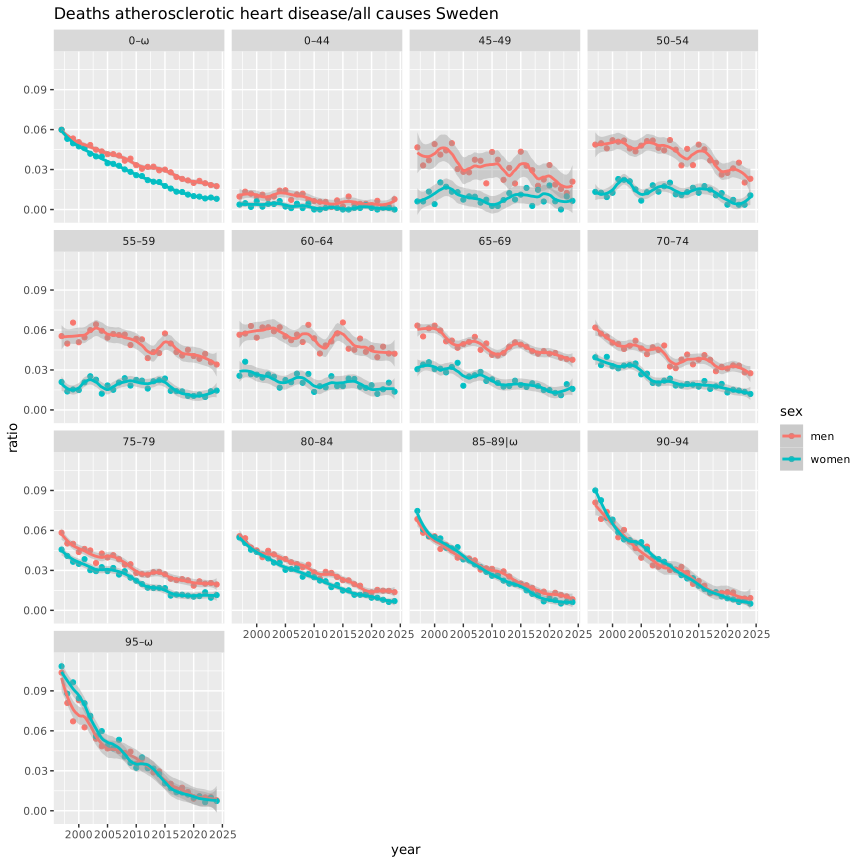
The graph shows that the proportion of deaths assigned to atherosclerotic heart disease/CVD has declined over time, and also that the sex composition of these deaths has changed: from 6.0 percent of all deaths among both women and men in 1997 to 0.8 percent of deaths among women and 1.8 percent of deaths among men in 2024. Moreover, their age distribution has changed in a way that may be surprising when circulatory diseases in general tend to get more concentrated to the highest age groups. In 1997, about 10 percent of deaths in the highest age groups, above 90 years, were ascribed to these causes. For the most recent years, the proportion there has declined to less than 1 percent, and the causes instead have their peak share among men aged around 60. This probably indicates that the causes nowadays are used in a much more restricted way than a few decades ago, but it would be desirable to do a more comprehensive study on the selection of I25.0 and I25.1 as underlying causes, in the style of Lindahl (1985).
References
The figures may be reproduced in R by cloning the blog repository and running
2026-09-26-2025.Rin the subdirectorypostdata/2026-09-26-2025.↩︎