Back to 2016
In my Swedish 28 Feburary 2016
post, I made some
forecasts on the future cause of death pattern in Sweden, using
age-specific death rates for ischemic heart disease, other circulatory
diseases, neoplasms, and other causes for the years 1999–2013, making
life tables based on the predicted death rates for future years, and
based on these calculating the probability of eventually dying from the
different causes, which I plotted for 2018, 2023, 2028, and 2033.
According to the forecasts, the probability of dying from neoplasm
(mainly cancer) would remain stable, while the probability of dying from
a circulatory disease would decrease, but not so much that the ratio
between circulatory disease and neoplasms would become lower than 1
during the period. This was contrary to some speculations in media that
cancer would soon become the most common cause of death
1
How have these predictions stood up so far? In my 4 July 2025 post, one could see the development of the cause pattern 2013–23: the proportion of cancer deaths has not changed significantly, while circulatory diseases, as a group, have declined but are still more common than neoplasms. However, for some Swedish regions, the circulatory/neoplasm ratio is below 1, as I discussed in my 28 September 2025 post, and this has been driven by decrease in circulatory disease, and not significant increase in neoplasms.
Now, there is a difference between the observed distribution of causes of death, which is simply the ratio between number of deaths for a subset of all causes and all deaths, and the distribution given by a life table. The former depends on the actual age distribution of the population, which is influenced by past mortality, fertility, and migration patterns, while the latter, which I used for my predictions, is independent of that. This is analogous to the difference between simple average age of death and life expectancy.
I have added functions to my morr R package, to combine age-specific cause proportions, based on data from WHO (2026), with life tables in the format given by University of California, Berkeley and Max Planck Institute for Demographic Research (2026), in order to calculate life table-adjusted cause patterns, as described above. Made with these functions, fig. 1 shows the raw cause pattern for all ages for Sweden 1951–2024, while fig. 2 shows the life table-adjusted distribution of causes that a newborn eventually would die of, given the age- and cause-specific mortality rates for each year.2
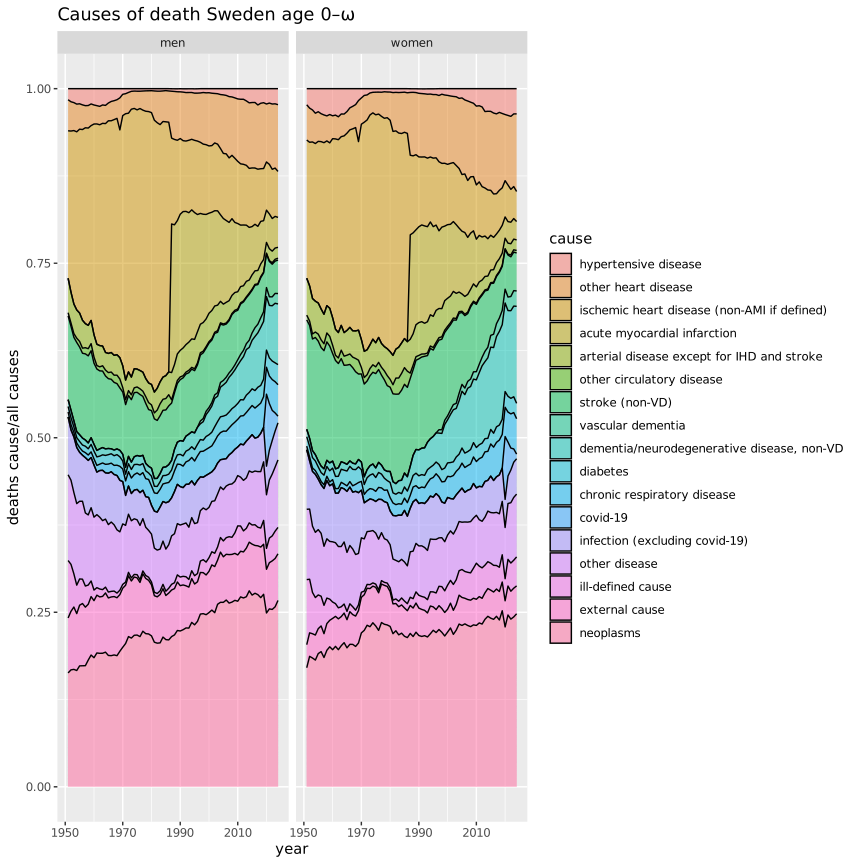
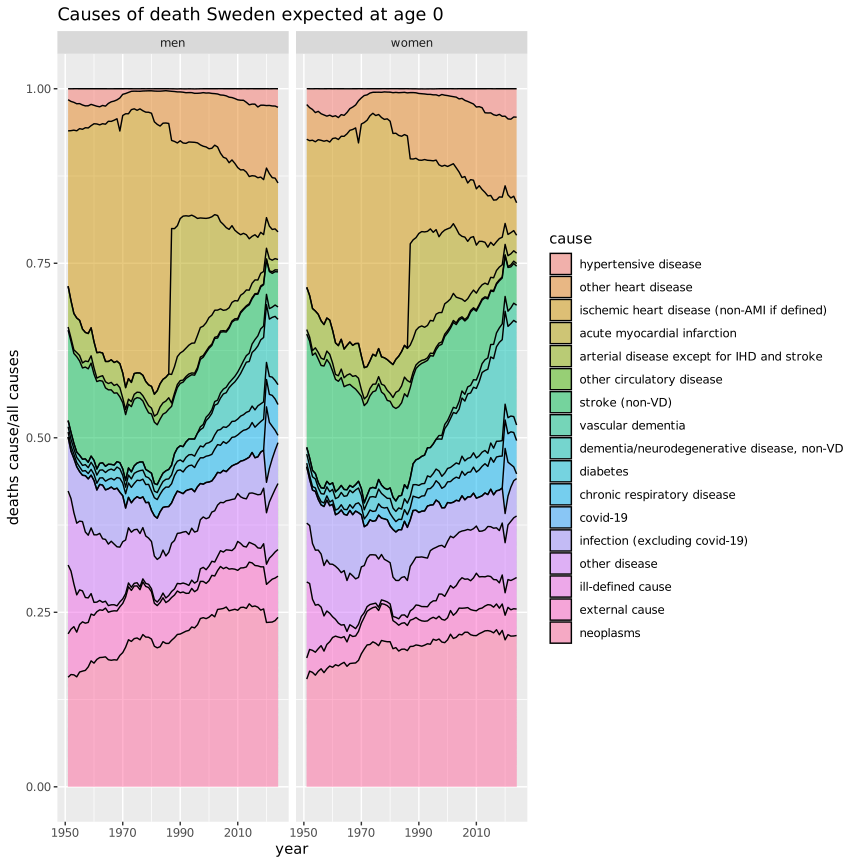
Comparing fig. 1 and fig. 2, the broad patterns and trends look similar, but there are some differences. The raw ratios tend to be skewed towards the mortality patterns in somewhat younger ages, due to the factors noted above, for example higher mortality rates in the past, so that the proportion living to age 90 in life tables for 2024 is higher than that proportion in the actual 1934 birth cohort.
In 2024, 31.1 and 30.7 percent of deaths among Swedish women and men were caused by circulatory causes (the categories in the graphs down to vascular dementia), but the life table calculated ratios were 33.5/33.0 percent. In 2013, the last observation used for my 2016 prediction, the raw ratios were 39.1/37.4 percent, and the life table ratios 40.4/39.2 percent. For neoplasms, relatively more common as a cause of death in middle-age, raw ratios were 24.8/26.7 percent in 2024, and life table-based ratios 21.7/24.3 percent. In 2013, raw ratios for neoplasms were 24.0/27.2 percent, and life table-based ratios 22.3/25.6 percent.
With the life table method, both circulatory disease and neoplasms have thus decreased somewhat in Sweden since 2013, among both women and men. They have also bounced back a bit after 2020, when covid-19 entered the scene and was most common as a cause of death during the first year, but in 2024, covid mortality had become so uncommon that continued future decrease can hardly alter the pattern for other causes.
One may also note how the period with at least 50 percent circulatory causes, as discussed in my 12 april, post becomes longer using the life table method: with raw ratios, it encompasses the years 1952–94 for women and 1956–91 for men, and with life table-adjusted rations, it begins in 1951 (the first year with available statistics) for women and ends in 1998, and encompasses 1953–95 for men.
As for the future development, it is important that 2026 will be the last year using ICD-10 for mortality statistics in Sweden, according to the published schedule (Socialstyrelsen 2026). With the adoption of ICD-11, cerebrovascular diseases will be moved from the circulatory chapter to the neurological chapter, and this may well result in the circulatory/neoplasm ratio being lower 1, if the numerator is defined by the circulatory chapter. However, it is trivial to include categories from other chapters for continuity, as I have done with cerebrovascular disease before ICD-8, and with vascular dementia in ICD-10. It remains to be seen to what extent the new classification will change the cause pattern in ways harder to adjust for.
References
It could, of course, be, and has been for many years, if you cut up the circulatory disease chapter in ICD-10 in subcategories with e.g. ischemic heart disease as the largest cause, but in these contexts, a partition based on the ICD chapters seems to have been mostly taken for granted.↩︎
The figures may be reproduced in R by cloning the blog repository and running
2026-04-26-2016.Rin the subdirectorypostdata/2026-04-26-2016. The causes are listed in thecapatvector in that file, using the cause definitions with ICD codes from the morr configuration file.↩︎